The Gentle Error Company – Where Joy Learns Fear
A vintage-minded psychedelic record where bright melodies, warm organs, and shadowed hooks turn innocence into unease.
There is a particular kind of brightness that does not comfort. It sits in the grass, in the window, in the morning road, in the clean shape of a bell or a hand — and then, slowly, it begins to turn.
Where Joy Learns Fear, the debut album by The Gentle Error Company, lives inside that turning point. It is a record built from pastoral images, uneasy melodies, vintage organ textures, melodic bass lines, dry drums, and guitar tones that lean toward warmth, fuzz, and fragile distortion rather than modern heaviness. Its world is not dark in the obvious sense. It is not theatrical, gothic, or aggressive. Instead, it works through contrast: simple things become uncertain, bright scenes develop shadows, and songs that first appear melodic and almost innocent begin to reveal something more troubled underneath.
Musically, the album moves through a vintage-minded blend of American psychedelia, blues-colored progressive rock, organ-driven arrangements, and dark melodic pop. The arrangements favor movement over excess: short vocal images, instrumental hooks, restrained harmonies, vintage keyboard colors, and guitar passages that expand the emotional space without turning the songs into modern rock workouts.
This is an album of fields, bells, windows, flowers, streets, glass, and morning light — but none of these images stay pure for long. Every object seems to carry a second meaning. Every melody has a shadow attached to it.
The Sound of the Album
The sound of Where Joy Learns Fear is deliberately organic. The album avoids modern polish and leans into analog-style warmth: dry live drums, melodic bass, warm organ, jangly clean guitar, brief flashes of fuzz, and vocal harmonies that feel human rather than glossy.
The record is not built around heaviness. Its tension comes from tone, arrangement, and atmosphere. A guitar phrase may bend slightly out of comfort. An organ figure may repeat just long enough to feel hypnotic. A refrain may sound catchy, but the words underneath it quietly unsettle the scene.
That balance is central to the album: melody and unease working together.
The first three tracks — “The Bell in the Field,” “Soft Teeth,” and “Paper Sun” — introduce the album’s dark psych-pop side. They are compact, melodic, and image-driven, each one turning a seemingly simple object into something unstable. After that, “Windows Full of Birds” breaks the pattern, replacing a conventional chorus with an instrumental hook and a late call-and-response vocal moment.
At the center of the album, “Slow Glass” becomes the record’s instrumental descent. Its slow pace, vintage organ color, and spacious guitar lines create a suspended atmosphere before the album returns to the human scale of “Bright Hands.”
From there, the second half grows more outward-facing. “No One Was Laughing” moves into a drier, more social space, while “They Walked Past the Flowers” carries a quiet sense of aftermath. The closing track, “The Morning Came Apart,” widens the album without resolving it too neatly. It does not end in triumph. It ends in recognition.
Tracklist
1. The Bell in the Field
2. Soft Teeth
3. Paper Sun
4. Windows Full of Birds
5. Slow Glass
6. Bright Hands
7. No One Was Laughing
8. They Walked Past the Flowers
9. The Morning Came Apart
Track-by-Track Breakdown
1. The Bell in the Field
The album opens with one of its clearest images: an empty field, a distant bell, and the strange silence that remains after play has ended. “The Bell in the Field” introduces the record’s main emotional language — brightness turning uncertain.
The song is melodic and restrained, carried by clean guitar, warm organ, and a rhythm section that never overstates itself. Its refrain feels simple on the surface, almost like a remembered children’s phrase, but the mood underneath is darker. The bell is not only a sound; it is a sign that something has changed.
Lyrically, the track sets the album’s world in motion:
“What was bright
Would not yield”
That line becomes a quiet key to the whole record. Joy does not disappear here. It resists, bends, and becomes something harder to name.
2. Soft Teeth
“Soft Teeth” sharpens the album’s sense of unease. Where the opening track begins in open air, this one feels closer and more dangerous. The imagery is intimate: fruit, skin, evening, sweetness, and a kind of hidden bite.
The song leans into a darker melodic hook, but it never becomes heavy in a conventional way. The guitars remain wiry and warm, the organ adds tension rather than thickness, and the rhythm keeps the song moving with a quiet pressure.
The title captures the track’s central contradiction: something gentle that still knows how to wound. It is one of the album’s most compact statements of sweetness turning unstable.
3. Paper Sun
“Paper Sun” is one of the album’s most immediate tracks. It has a brighter surface, almost like a psych-pop single from another decade, but the brightness is intentionally fragile. The sun here is handmade, temporary, and too light to survive the day.
The arrangement plays with that contrast. Jangly guitars and organ lines give the track lift, while the minor-key atmosphere keeps it from becoming purely cheerful. The chorus is memorable, but not reassuring.
The song’s central image — a paper sun tied too high — works as a miniature version of the album itself: beauty constructed, held up, and slowly coming loose.
4. Windows Full of Birds
“Windows Full of Birds” marks the album’s first real structural break. Instead of a traditional chorus, the track relies on an instrumental hook and a late vocal exchange. This gives the song a more suspended, slightly uncanny feeling.
The setting is enclosed: a room after hours, dust across the floor, windows reflecting birds that may or may not be outside. The song turns perception into uncertainty. Are the birds real, reflected, remembered, or imagined? The track never answers.
Musically, this is where the album begins to open its arrangements. The organ and guitar become more conversational, while the bass moves underneath with subtle melodic force. The result is strange but still songful — a small chamber of doubt in the middle of the record’s first half.
5. Slow Glass
“Slow Glass” is the album’s instrumental centerpiece.
It moves slowly, almost like a room changing shape in low light. The track is built around vintage organ tones, spacious guitar phrases, melodic bass movement, and a dark, suspended pulse. There is no vocal narrative here; the atmosphere carries the meaning.
The piece gives the album room to breathe. After four vocal tracks, “Slow Glass” opens a deeper space — more hypnotic, more nocturnal, and less direct. Its guitar passages stretch without becoming flashy, and the organ color gives the track a slightly haunted edge.
It is not an interlude. It is the hinge of the album.
6. Bright Hands
After the instrumental descent of “Slow Glass,” “Bright Hands” returns the album to human scale. The song is built around a workshop image: hands, wood, dust, unfinished objects, and the quiet dignity of work.
The track is warm, but not innocent. There is tenderness in the melody, yet the lyric suggests memory, scars, and things hidden beneath ordinary gestures. It is one of the album’s most understated songs, and that restraint is part of its strength.
The delayed refrain —
“Some hands make light
Some hands remember”
— gives the song its emotional center without turning it into a conventional chorus. It feels like a sentence discovered rather than declared.
7. No One Was Laughing
“No One Was Laughing” moves the album outward. The private symbols of the earlier tracks give way to a more public scene: shutters closing, baskets in line, adults watching, a boy standing near a fountain with his cap turned inside out.
The song is drier, more rhythmic, and more socially observant. Its tension comes from restraint. The title appears only as a late vocal hook, which makes the line feel less like a chorus and more like a realization.
This is one of the album’s most important turns. It suggests that the loss of innocence is not only personal or symbolic. It also exists in the street, in routine, in the way people watch each other without speaking.
8. They Walked Past the Flowers
“They Walked Past the Flowers” is quieter, but no less unsettling. It follows the social dryness of “No One Was Laughing” with something more resigned and ghostly.
The track does not dramatize its scene. People walk past flowers. Rain is on their shoes. The sky carries a bruise. No one bends to gather what has fallen. The emotion is in the refusal to stop.
Musically, the song stays restrained and unresolved. The late vocal couplet —
“By evening they knew
What silence could do”
— gives the track a final weight without needing a repeated refrain. It is one of the album’s most economical lyrical moments.
9. The Morning Came Apart
The closing track, “The Morning Came Apart,” brings the album back to the road.
It begins gently, without rushing toward resolution. The scene is open: a town behind, a pale line in the east, fences coming into view, movement without explanation. The song feels like departure, but not escape. Something has changed, and the characters know it before they say it.
The final refrain arrives late, almost as a release:
“Let the morning come apart
Let the morning come apart
Not to break us
Only to show where we are”
This is not a triumphant ending. The album does not solve its unease. Instead, it allows the unease to become visible. The morning comes apart, and in that breaking, something honest appears.
The Single: The Good Child Ran Away
Alongside the album, The Gentle Error Company also released the single “The Good Child Ran Away.”
While Where Joy Learns Fear moves like a full album arc, “The Good Child Ran Away” works as a sharper standalone piece. It is brighter, quicker, and more immediately melodic, but it belongs to the same world: polite surfaces, rural light, open gates, and the sudden realization that obedience is not the same as joy.
The song begins with a scene of order:
“They dressed her in a Sunday color
And told her where to stand”
From there, the track turns into a small act of escape. The chorus is more direct than most of the album’s vocal hooks, giving the single its immediate pull:
“Run where the wheat bends sideways
Run where the white walls end
Run before the kind ones notice
Joy has learned to pretend”
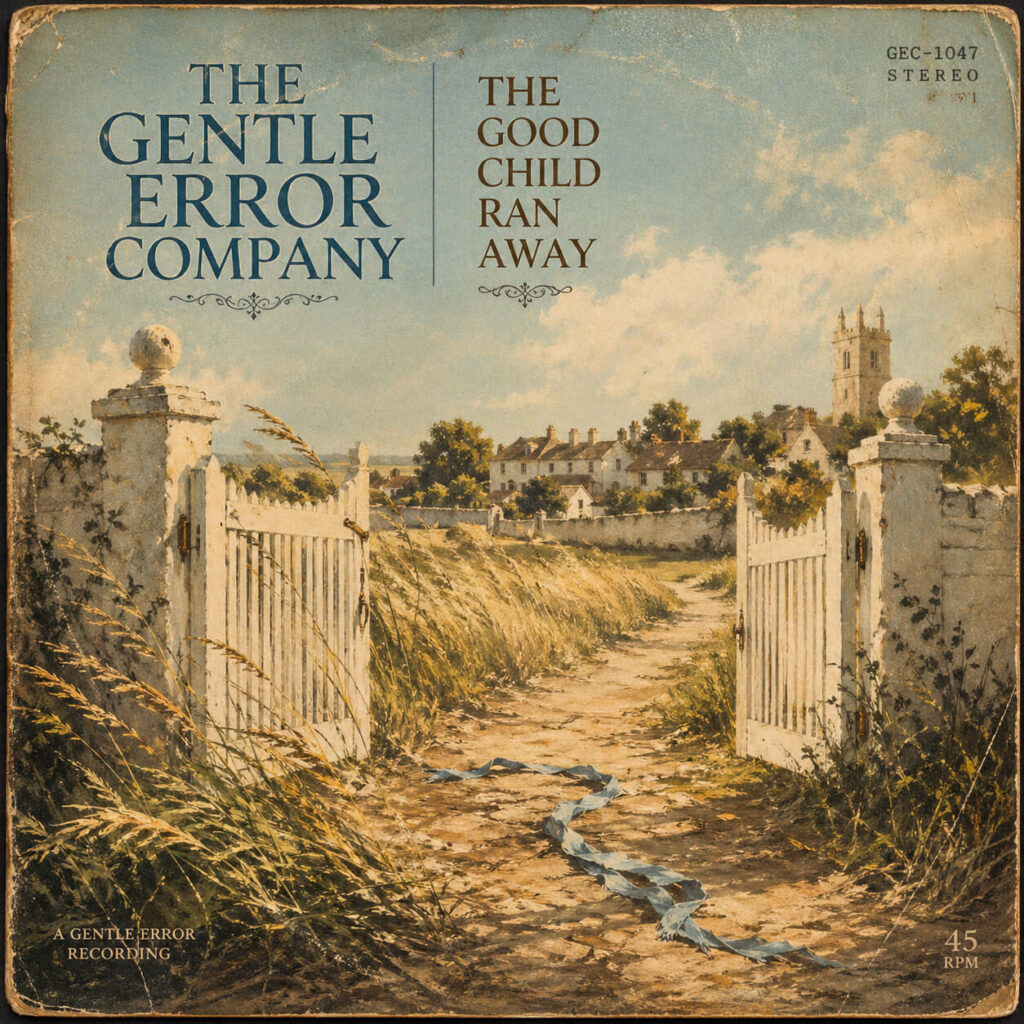
The single cover captures the idea perfectly: an open white gate, a fallen ribbon, and a path leading away from a village morning. No figure is shown, because the absence is the story. Someone has already left.
As a companion piece, “The Good Child Ran Away” extends the album’s central emotional world while giving it a more brisk and accessible form.
Artwork and Visual Identity
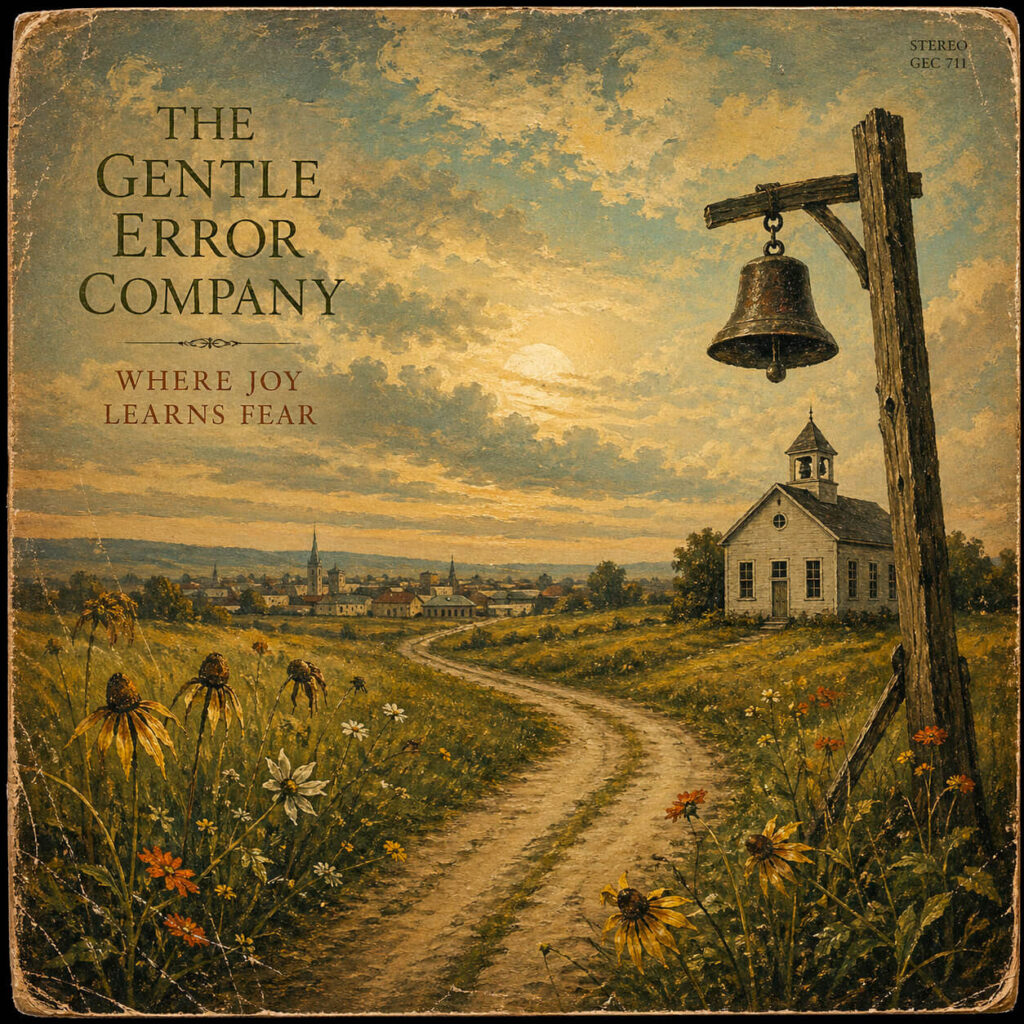
The visual world of *Where Joy Learns Fear* is as important as its sound. The album cover presents a pastoral landscape that feels beautiful at first glance: a road, a field, flowers, a bell, a distant building, a pale sky. But the longer one looks, the more uncertain the image becomes.
The bell suggests order, ritual, warning, and memory. The road curves away from the viewer. The flowers lean as if affected by a force just outside the frame. The schoolhouse or chapel-like building in the distance adds a quiet institutional presence, neither comforting nor openly threatening.
The single artwork continues this language in a more direct way. The open gate and fallen ribbon suggest a departure that has already happened. Like the music, the images do not explain themselves. They leave traces.
Final Thoughts
Where Joy Learns Fear is a record about the moment when brightness becomes aware of its own shadow. It is melodic without being simple, vintage-minded without being nostalgic cosplay, and dark without relying on obvious darkness.
Its strongest quality is restraint. The album rarely pushes too hard. It lets small images carry emotional weight: a bell in a field, a bruise-colored sky, hands covered in dust, a morning road, a window full of birds.
The result is a compact psychedelic album with a distinct identity — pastoral, uneasy, melodic, and quietly strange.
Listen and Support
Listen to Where Joy Learns Fear by The Gentle Error Company on your preferred streaming platform.
Watch the official videos on YouTube and Rumble, and support the project through merch and music links below.
The Gentle Error Company
Where Joy Learns Fear
Album
 Spotify
 Apple Music
 YouTube Music
 TIDAL
TIDAL
 Amazon Music
– Listen / Stream: INSERT_STREAMING_LINK_HERE
– Watch on YouTube: INSERT_YOUTUBE_LINK_HERE
– Watch on Rumble: INSERT_RUMBLE_LINK_HERE
– Buy / Listen on Amazon: INSERT_AMAZON_AFFILIATE_LINK_HERE
– Merch: INSERT_FOURTHWALL_LINK_HERE
Curious about the creative workflow behind AI Lab Craft releases? Visit The Method, where we explain the editorial, ethical, and artistic process behind our music projects.